 The “6th Ethics Council” (Ahlâk Şûrası) was held, hosted by the Islamic Civilisation Application and Research Centre of Hasan Kalyoncu University (HKU), in partnership with the Institute of Islamic Thought and the Turkish Writers Union. The Council aimed to address the contemporary moral crisis from many perspectives and to share the search for solutions with the public.
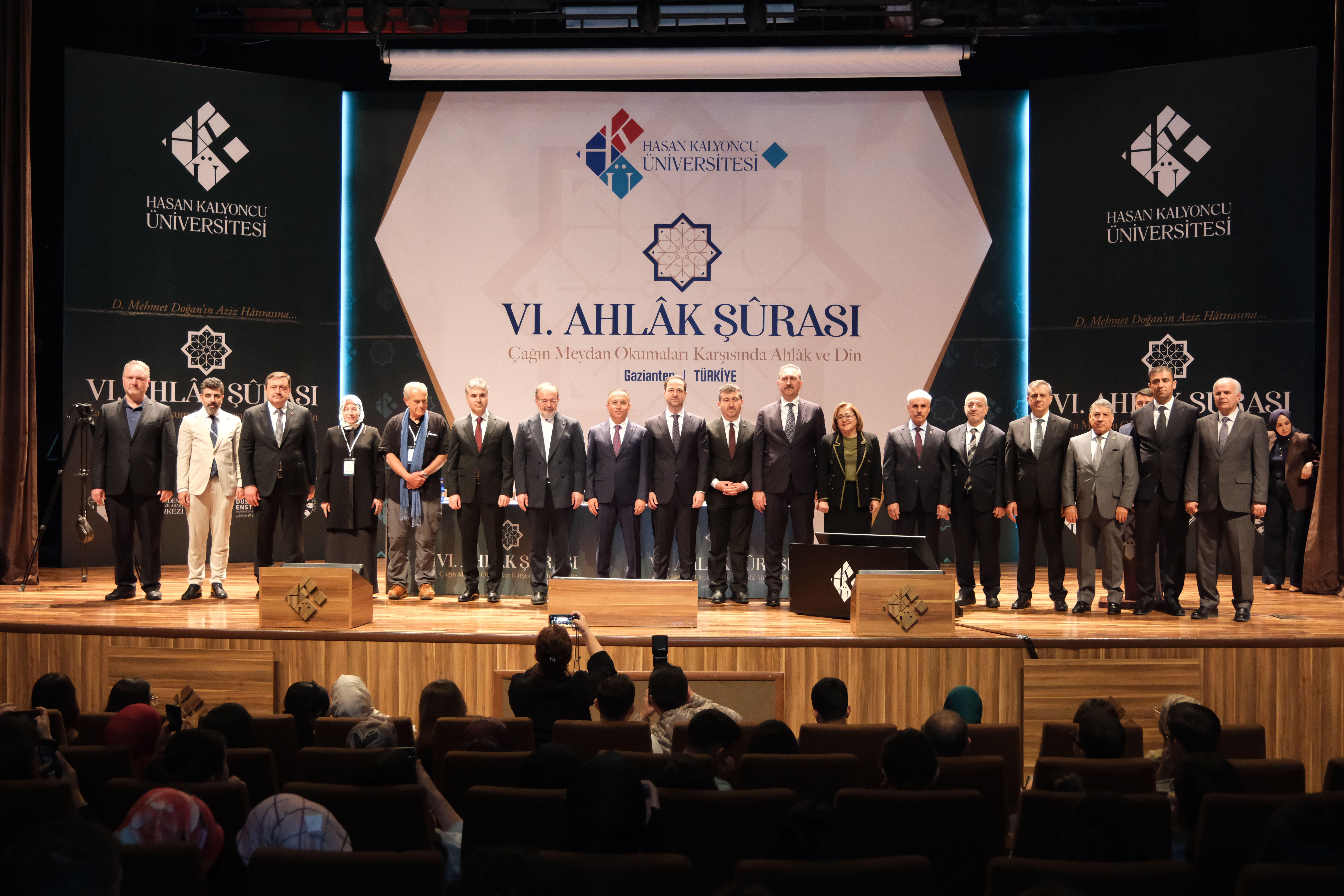
The Council, now in its sixth year, was attended by AK Party Deputy Group Chair Abdulhamit Gül, Governor of Gaziantep Kemal Çeber, Gaziantep Metropolitan Municipality (GBB) Mayor Fatma Şahin, HKU Board of Trustees Chair Haluk Kalyoncu, HKU Rector Prof. Dr. Türkay Dereli, Rector of Ankara Social Sciences University (ASBÜ) and Chair of the Turkish Writers Union (TYB) Prof. Dr. Musa Kazım Arıcan, Chair of the Institute of Islamic Thought (İDE) Prof. Dr. Mehmet Görmez, Chair of the Council Executive Board Esra Kalyoncu Değerli, academics and students.
President Recep Tayyip Erdoğan also contributed to the Council by sending a message. In his message, Erdoğan stated: “At the 6th Ethics Council, I believe that views will be put forward that address the causes of moral deformation, one of the most important problems of our world, approach the Islamic sciences in their various dimensions with regard to the solution, and contribute to resolving it. I wish success to the Council, which is dedicated to the blessed memory of Mehmet Doğan, one of the most valuable intellectuals our country has produced.”
Chair of the Institute of Islamic Thought (İDE) Prof. Dr. Mehmet Görmez said: “When we speak of the challenges of the age, we human beings are quite skilled at blaming time for our faults. In order not to take the blame, we blame either time, or the age, or the century. Yet the age cannot actually challenge us; we are challenging ourselves. Our own evils are challenging us. It is essentially the evils people commit that pose the challenge. But, taking change and transformation into account, we load this onto the age, and we find some relief by casting our faults upon it. In truth, the greatest crisis that our age and humanity are experiencing is neither a political crisis nor an economic crisis. No crisis affects humanity as deeply as a crisis of meaning and a moral crisis. This is the fundamental crisis facing all of humanity today. Indeed, for nearly two years all of humanity has been going through a great test in Gaza. The children and mothers of Gaza cry out in all our faces to show what kind of crisis of conscience, meaning and morality humanity has been dragged into. Truly, all of humanity has failed the class on this point. The most fundamental aim of our Council is to re-establish the relationship between human beings and morality. Because from time to time we try to define morality merely as a part of behavioural science, a set of rules that adorn our behaviour. Yet morality is our existential matter. We human beings have two aspects: one is our material existence – our body, our corpse, our eyes, our ears… and so on; the other is our spiritual, metaphysical existence. That is our morality. We call the first ‘halk’ and the second ‘hulk’. One who has no ‘hulk’ loses his ‘halk’ as well. Morality is the essence of our existence. What makes us who we are and sets us apart from other living beings is the lofty values we possess.”
HKU Board of Trustees Chair Haluk Kalyoncu, noting that morality is a fundamental value that determines not only the lives of individuals but also the fate of societies, said: “Today, here, together with our very esteemed scholars, our valued professors and our respected elders, we are gathered at this ethics workshop, on a subject that is our spiritual value forming the fundamental dynamics of society and a treasure of our national spirit. We believe that this Council will have concrete outcomes over its two days. Our university was founded as a manifestation of a foundation ethos, an idea and a philosophy of service to people. We thank our professor Prof. Dr. Mehmet Görmez, former President of the Presidency of Religious Affairs (Diyanet), a member of the council of thinkers involved in the founding work and the founder of the Institute of Islamic Thought, for leading the placing of such an important subject on the agenda and for enabling it to be held with our university as host. Since the early 1980s, the Gaziantep Education and Service Foundation has carried out work in Gaziantep serving learning, science and youth; it brought Erdem Schools to our country in 1998 and, in 2008, the first foundation university of our Southeastern Anatolia Region.”
ASBÜ Rector and TYB Chair Prof. Dr. Musa Kazım Arıcan said: “Unfortunately, religion’s capacity to produce knowledge, to build a life based on morality, to construct human life, and to establish the integrity of the individual and society has come to be questioned. This understanding has enveloped all of humanity. Particularly in the Islamic world after the 19th century, minds oscillating between admiration and an inferiority complex in the face of the West’s scientific and technological superiority have unfortunately remained weak in defending the fundamental claims of religion.”
Speaking at the opening of the Council, HKU Rector Prof. Dr. Türkay Dereli said: “Another area to which Hasan Kalyoncu University attaches as much importance as scientific production is values education and a civilisational perspective. In this context, hosting such a meaningful council together with our Islamic Civilisation Application and Research Centre is for us not merely an academic responsibility, but an expression of our commitment to the values we believe in. Moreover, the fact that this meaningful council is organised in dedication to the blessed memory of Mehmet Doğan, a valued scholar and man of ideas who made profound contributions to our intellectual world, lends it special significance. May his soul rest in peace.”
AK Party Deputy Group Chair Abdulhamit Gül said: “We are all experiencing together the period in which the West, which tries to build a civilisation with the understanding that ‘man is a wolf to man’, has subjected humanity to great turmoil. The vision of civilisation held by the global powers that claimed to give the world a new order with the 1945 Yalta Conference has been fundamentally corrupted. Since 1945, the ‘new world order’ has made no notable contribution to humanity. Today, an atrocity is taking place in Gaza in which 200 people were killed in just two days. The only way to eliminate the turmoil caused by this Western civilisation, which has brought more blood and more oppression to humanity, civilisation and the world, is the construction of a civilisation based on morality. For this reason, this Council, which demonstrates that a spirit and a morality will prevail against the challenges of the age, is extremely valuable.”
Governor of Gaziantep Kemal Çeber said: “Religion is morality, and morality is religion. When these are present, morality-based public order offences disappear, and we would not be discussing the fight against addiction in Gaziantep. We would not be discussing litter thrown on the ground or cleanliness. I am extremely hopeful about young people. Do not hold yourselves back from reading, listening and finding the truth. Do not become people who do the very things you criticise. I am hopeful about each and every one of you.”
GBB Mayor Fatma Şahin said: “Evliya Çelebi travelled the whole world, and when he came here he called it ‘Şehr-i Ayıntab-ı Cihan’. Saying ‘neither pen nor speech suffices to describe this city’, he expressed the greatness of Gaziantep. This city is the City of Civilisation; this city is the City of Prayer. This city is the City of the Ansar, which made Yathrib into Medina. To be the mayor of this city, its trustee (Şehr-i Emin), is a great trust, a great honour and a great responsibility. With this responsibility, and with awareness of serving in this city that has raised figures such as Bedreddin Aynî, Ahmet Mithat Küçükçınar, Mehmet Ziylan and Mehmet Görmez, we continue our work. May God be pleased with everyone who has contributed to this Council.”
Following the opening speeches, in the opening panel titled “Revealing the Moral Crises of the Age”, chaired by ASBÜ Rector and TYB Chair Prof. Dr. Musa Kazım Arıcan, İDE Chair Prof. Dr. Mehmet Görmez addressed “The Ethics of Modesty in the Digital World”, while Specialist Psychiatrist Dr. Mustafa Merter gave an assessment on “The Final War: The Project of Restructuring Humanity and Morality”. Merter spoke of the existence of a multidimensional war being waged against humanity.
At the 6th Ethics Council, which will last three days and in which the social, cultural and intellectual dimensions of current problems will be discussed in comprehensive sessions, strong theoretical and practical searches for solutions to the value crisis of our age will be discussed and deliberated in sessions titled “Human – Fitrah, Morality and Law”, “Morality, Religion and Life”, “Moral Problems Caused by the Modern Era”, “Morality and Religion in the Face of the Challenges of the Age” and “The Reconstruction of the Islamic Sciences on Morality”.