
Work on renewable energy sources continues all over the world. One of the areas where work has intensified is photovoltaic systems, which generate electricity using sunlight. In this context, Hasan Kalyoncu University (HKU) continues its success as the first university in Türkiye to generate renewable energy.
The Ministry of Energy and Natural Resources of the Republic of Türkiye stated that, with the “Türkiye National Renewable Energy Action Plan” it announced, it has set out the country’s energy policy and strategy for the years 2015-2023. It was announced that, according to the determined strategy, energy consumption will double by 2023 compared with today, and that the aim is to raise the capacity of solar energy systems to 3,000 MW by using more renewable energy sources to meet demand.
More Than 170 Tonnes of CO2 Emissions Prevented Thanks to the Solar Power Plant
Hasan Kalyoncu University Rector Prof. Dr. Tamer Yılmaz stated that there is a solar power plant with a capacity of 196 kWp, using photovoltaic technology, on the roof of the university’s School of Health Sciences building, and that the energy produced by the plant is primarily used for self-consumption. Rector Yılmaz said that the surplus remaining after self-consumption is met is transmitted to the grid, and added: “our surplus production is sold to the electricity distribution company serving Gaziantep at the price determined under the ‘Regulation on Unlicensed Electricity Generation in the Electricity Market.’ The status and production values of the plant can be monitored online in real time, and are presented as a report every month by KALİTTO (Kalyoncu Innovation and Technology Transfer Office). The solar power plant, which has been in operation for eight months, has prevented more than 170 tonnes of CO² emissions with the approximately 292,260 kWh of green energy it has produced.
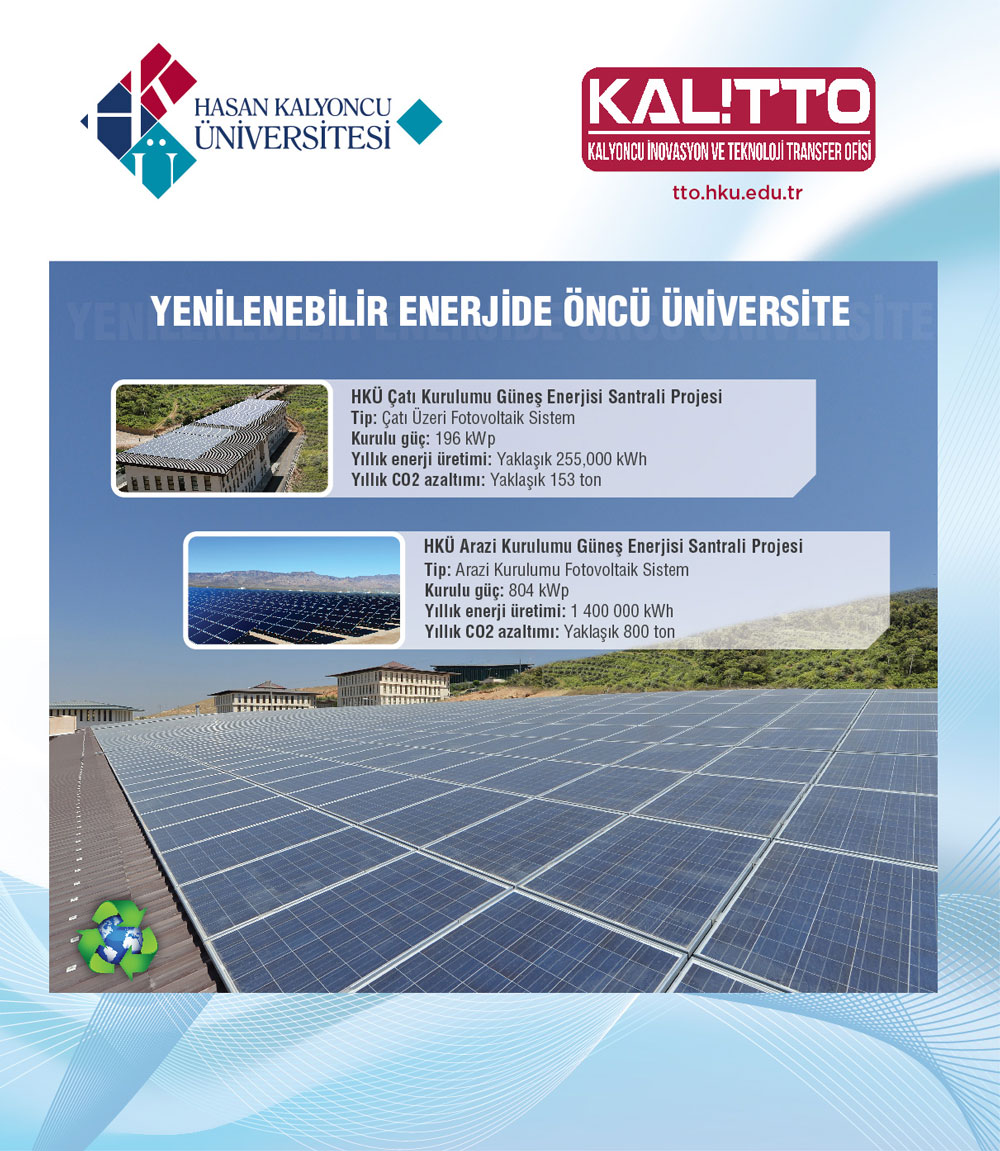
Unlicensed producers are permitted to build plants of up to 1 MW. In order to use our remaining capacity as well, our office KALİTTO has completed the official procedures and obtained permits for a new plant. As a result, with the “Solar Field” to be built on an area of 16,000 m² determined on our university’s land, nearly all of Hasan Kalyoncu University’s energy consumption will be obtained from renewable energy sources,” he said.